1,530,275
Trajectories
Capture • Dataset • Evaluation
AXIS
A Growable Community-Driven Data Engine
for Scalable Robot Manipulation
1Axis Robotics 2University of California, Berkeley 3Georgia Institute of Technology 4Texas A&M University 5Johns Hopkins University 6University of Pennsylvania 7University of Michigan 8National University of Singapore 9Nanyang Technological University
Real-time statistics
1,816
Tasks
13,645 h 7 m
Trajectory duration
Data is verified every hour. Task growth uses the latest complete UTC day.
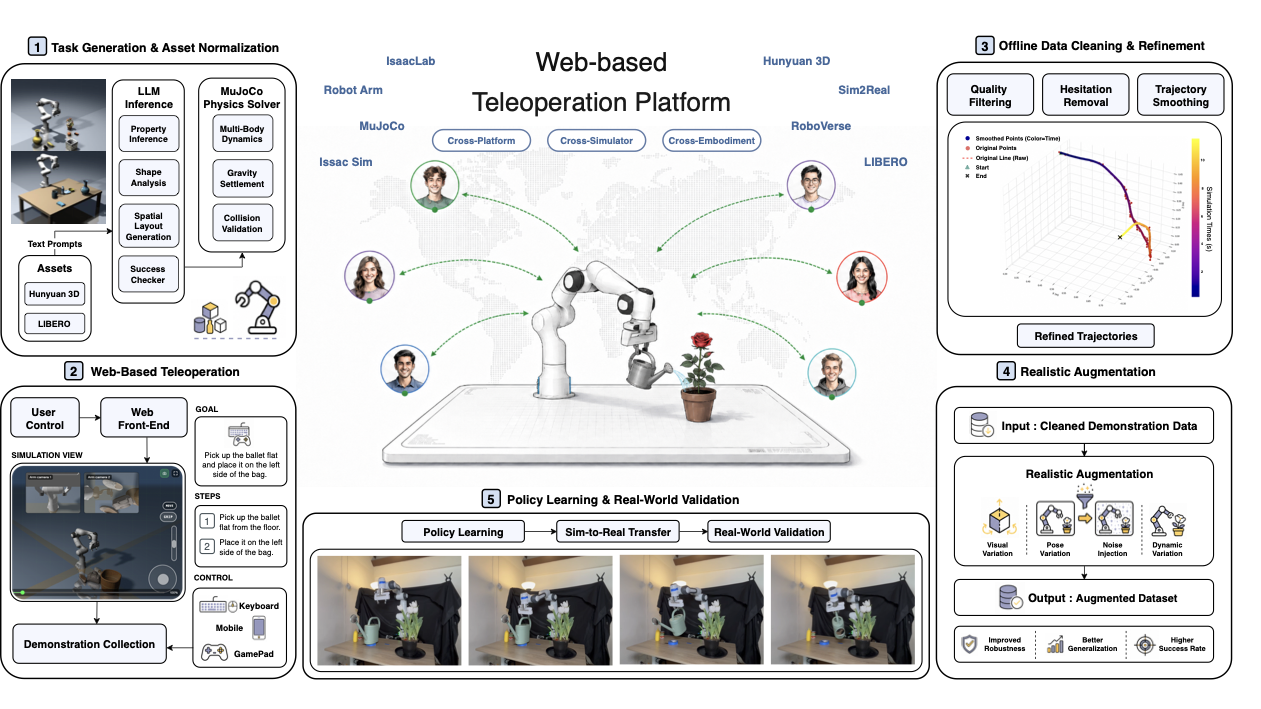
AXIS system overview: task generation, browser-based teleoperation, offline data processing, simulation augmentation, policy learning, and real-world validation.
Abstract
Learning effective robot manipulation policies requires diverse, high-quality demonstrations, yet existing data pipelines are often difficult to scale because they rely on specialized hardware, centralized operators, or fixed task suites. We present AXIS, a growable community-driven data engine and benchmark for scalable robot learning, which enables browser-based teleoperation for large-scale demonstration collection, automatically generates and validates new manipulation tasks, and transforms community-collected demonstrations into training-ready data through automated success checking, quality filtering, trajectory smoothing, and visual and physics-based augmentation.
The AXIS dataset currently contains 207 diverse tasks and 50K+ trajectories. Meanwhile, AXIS organizes data into task snapshots and evaluates policies with a systematic held-out protocol. We compare vision-language-action (VLA) policies under a unified AXIS evaluation suite and analyze scaling behavior across different data volumes.
Continual pretraining on AXIS substantially improves the overall success rate of π0.5 by 5.8%, outperforms the model pretrained on RoboCasa365 by 37.3%, and exhibits consistent scaling with increasing data volume, with the largest gains observed under layout, sensor-noise, and camera perturbations.
Scalable Robot Data Collection
Collection stays lightweight in the browser; validation, rendering, augmentation, and learning run on the backend.
The AXIS collection layer separates latency-sensitive teleoperation from compute-heavy data processing. Contributors operate a Franka Research 3 arm in a MuJoCo-WASM browser frontend with commodity input devices, while uploaded trajectories are routed to backend machines for validation, cleaning, replay, rendering, augmentation, and export.
Data engine stages
- 01 Task generation and asset normalization
- 02 Web-based MuJoCo-WASM teleoperation
- 03 Success checking and trajectory upload
- 04 Filtering, hesitation removal, smoothing, and resampling
- 05 IsaacSim visual and physics augmentation
- 06 VLA training, fixed-protocol evaluation, and real-world rollout
Browser teleoperation
Contributors collect demonstrations without local simulator installation, GPUs, or specialized robot hardware.
Unified trajectory format
Each episode stores task metadata, embodiment, simulator version, observations, states, actions, and success information.
Quality refinement
Backend validation removes corrupted records, failed tasks, idle segments, jitter, and nonphysical discontinuities.
Realistic augmentation
Scene, camera, lighting, texture, pose, friction, mass, and dynamics variations expand the training distribution.
The AXIS Franka Dataset
AXIS is a tabletop manipulation dataset built around a Franka Research 3 robot with a parallel-jaw gripper. Each task includes a language instruction, a parameterized simulation scene, task assets, and a structured success checker. Each trajectory provides synchronized robot states, object states, robot actions, task metadata, success labels, and multi-view RGB-D observations.
Dataset snapshot
- Tasks
- 207
- Trajectories
- 50K+
- Task/scene variants
- 60K+
- Robot
- Franka Research 3
- Cameras
- Third-view + wrist RGB-D
- Evaluation
- Fixed held-out protocol
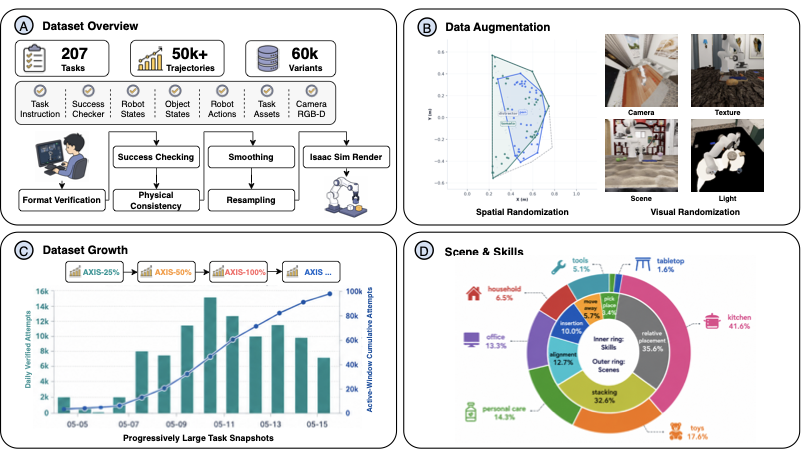
Trajectory refinement
Raw community demonstrations may contain hesitation, jitter, low-frequency sampling artifacts, or invalid transitions. AXIS filters and refines these demonstrations before converting them into policy-learning data.
| Data Version | Sampling Rate | Mean Acceleration | Mean Jerk | Replay Success |
|---|---|---|---|---|
| Raw Teleoperation | 5.0 Hz | 1.3539 | 11.5899 | 100.0% |
| Smoothed | 5.0 Hz | 0.6382 | 2.9160 | 91.4% |
| Smoothed + Resampled | 20 Hz | 0.4885 | 2.2243 | 86.2% |
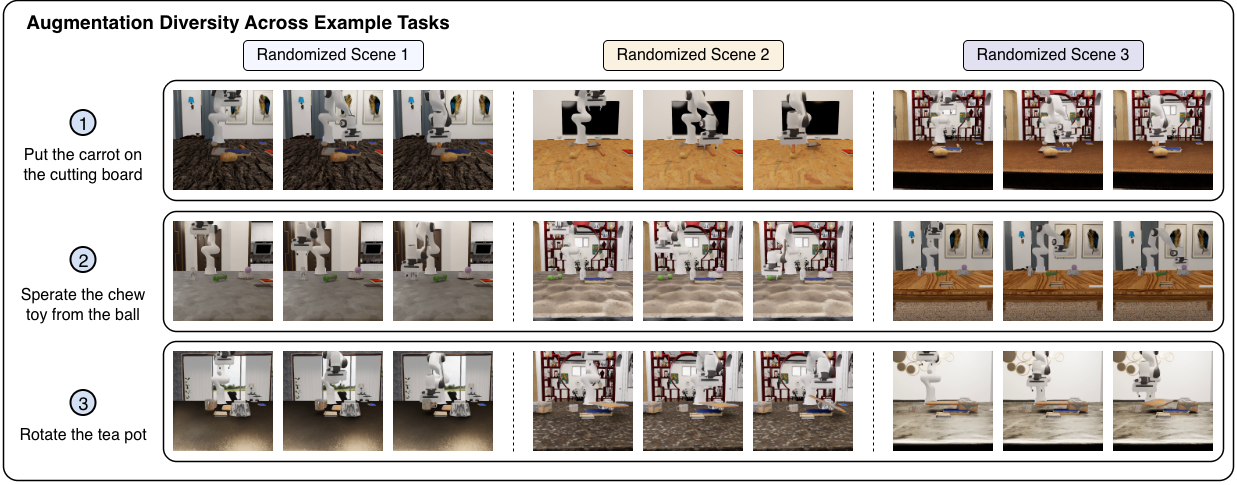
A living benchmark
Instead of treating the dataset as a one-time release, AXIS organizes training data into progressively larger snapshots. AXIS-25%, AXIS-50%, AXIS-100%, and future versions preserve shared data format, task definitions, success checkers, rollout budgets, and evaluation tasks, so scaling studies can isolate the effect of training coverage.
AXIS-25%low-volume scaling point
AXIS-50%mid-scale task coverage
AXIS-100%current full snapshot
AXIS-...future growable releases
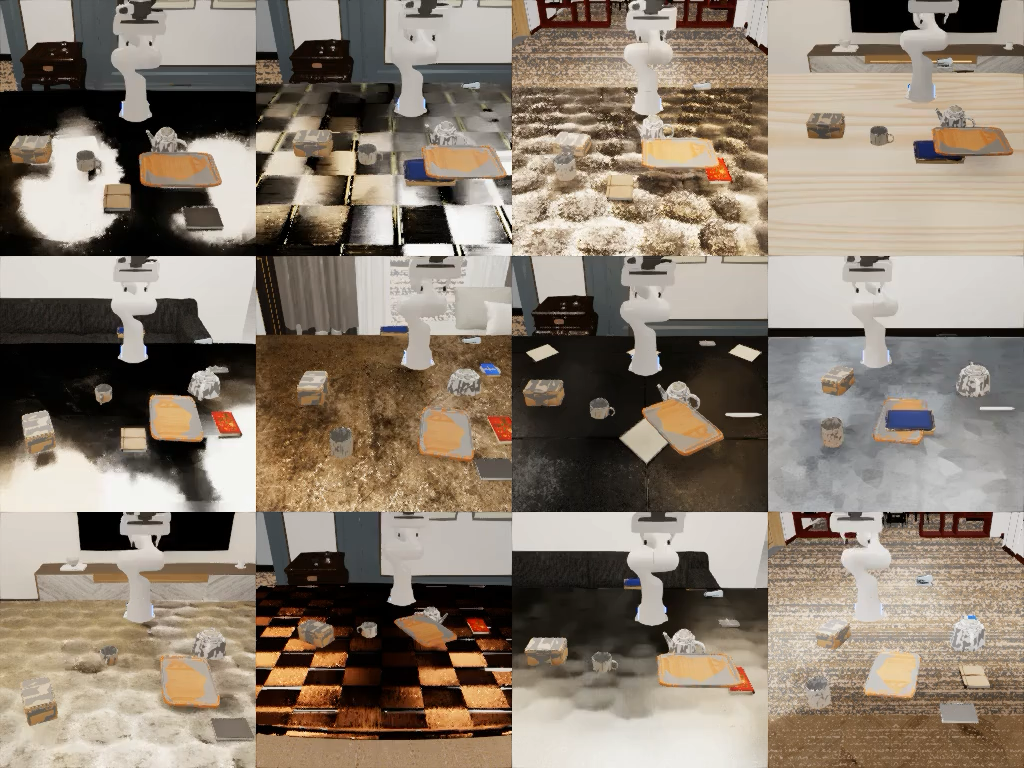
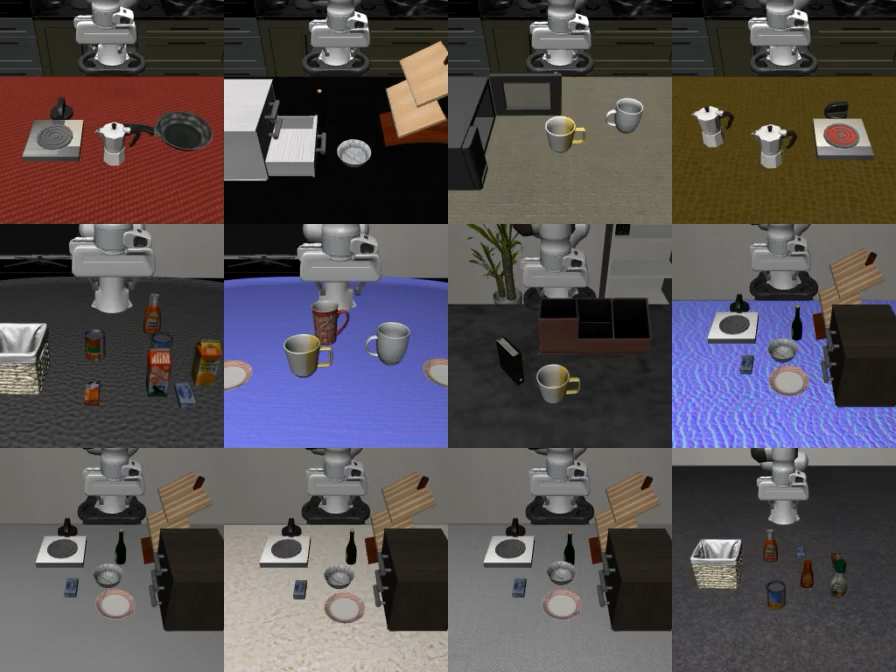
What the dataset contains
language instruction
task assets
success checker
robot states
object states
robot actions
third-view RGB-D
wrist RGB-D
metadata
failure labels
Simulation demos
Experiments
The experiments evaluate whether AXIS pretraining improves downstream LIBERO-Plus robustness for π0.5, whether the improvement scales with AXIS data volume, and which perturbation axes benefit most from AXIS-style augmentation and task diversity.
Headline result.
π0.5 + AXIS-100% reaches 88.8 overall LIBERO-Plus success, compared with
83.9 for vanilla π0.5 and 57.5 for a RoboCasa-matched simulation baseline.
| Pretraining | # demos | Overall ↑ | Cam. | Light | Noise | B.G. | Layout | Lang. | Robot |
|---|---|---|---|---|---|---|---|---|---|
| π0.5 vanilla | 0 | 83.9 | 72.5 | 98.2 | 82.5 | 94.4 | 82.9 | 89.6 | 74.4 |
| π0.5 + AXIS-25% | 0.25 NAXIS | 84.7 | 77.5 | 91.2 | 86.2 | 100.0 | 85.5 | 81.8 | 76.9 |
| π0.5 + AXIS-50% | 0.50 NAXIS | 85.7 | 68.8 | 98.2 | 91.2 | 96.3 | 88.2 | 84.4 | 79.5 |
| π0.5 + AXIS-100% (ours) | NAXIS | 88.8 | 83.8 | 96.5 | 96.2 | 98.1 | 85.5 | 88.3 | 78.2 |
| π0.5 + RoboCasa-matched | NAXIS | 57.5 | 35.2 | 79.5 | 63.2 | 81.7 | 68.0 | 49.2 | 39.4 |
Per-perturbation robustness
Sensor Noise
+13.7Largest gain over vanilla; robustness improves under photometric observation shifts.
Camera
+11.3Viewpoint variation transfers to LIBERO-Plus camera shifts.
Robot Pose
+3.8AXIS helps beyond explicitly randomized perturbation axes.
Background
+3.7Scene and texture randomization improves background robustness.
| Axis | π0.5 vanilla | + AXIS-25% | + AXIS-100% | + RoboCasa-m. | ∆van | AXIS−RC |
|---|---|---|---|---|---|---|
| Camera | 72.5 | 77.5 | 83.8 | 35.2 | +11.3 | +48.6 |
| Light | 98.2 | 91.2 | 96.5 | 79.5 | −1.7 | +17.0 |
| Sensor Noise | 82.5 | 86.2 | 96.2 | 63.2 | +13.7 | +33.0 |
| Background | 94.4 | 100.0 | 98.1 | 81.7 | +3.7 | +16.4 |
| Layout | 82.9 | 85.5 | 85.5 | 68.0 | +2.6 | +17.5 |
| Language | 89.6 | 81.8 | 88.3 | 49.2 | −1.3 | +39.1 |
| Robot | 74.4 | 76.9 | 78.2 | 39.4 | +3.8 | +38.8 |
| Overall | 83.9 | 84.7 | 88.8 | 57.5 | +4.9 | +31.3 |
Real-world rollouts
BibTeX
BibTeX
@article{zhao2026axis,
  title   = {AXIS: A Growable Community-Driven Data Engine for Scalable Robot Manipulation},
  author  = {Mengfei Zhao and Dihong Huang and Yikai Tang and Peihao Li and Mingxuan Yan and Ruiqi Zhuang and Yanjia Huang and Jie Wang and Hai Zhai and Tony Zhou and Rui Zhang and Zhexi Luo and Yuchen Huang and Jianfei Yang and Jiachen Li},
  journal = {arXiv preprint arXiv:2607.21588},
  year    = {2026},
  url     = {https://arxiv.org/abs/2607.21588}
}